Rules in plain language
Describe a rule as you would to a colleague and it becomes exact conditions you can read, per person, team or system. Each rule allows, asks or blocks.

Loophold
Loophold stands between AI agents and your company: you write the rules, the people responsible approve the sensitive actions and every step is recorded in a tamper-evident log. Agents never get hold of your credentials.
Who it’s for: Companies using AI agents on code, email and databases, and the system integrators who run it for their clients.
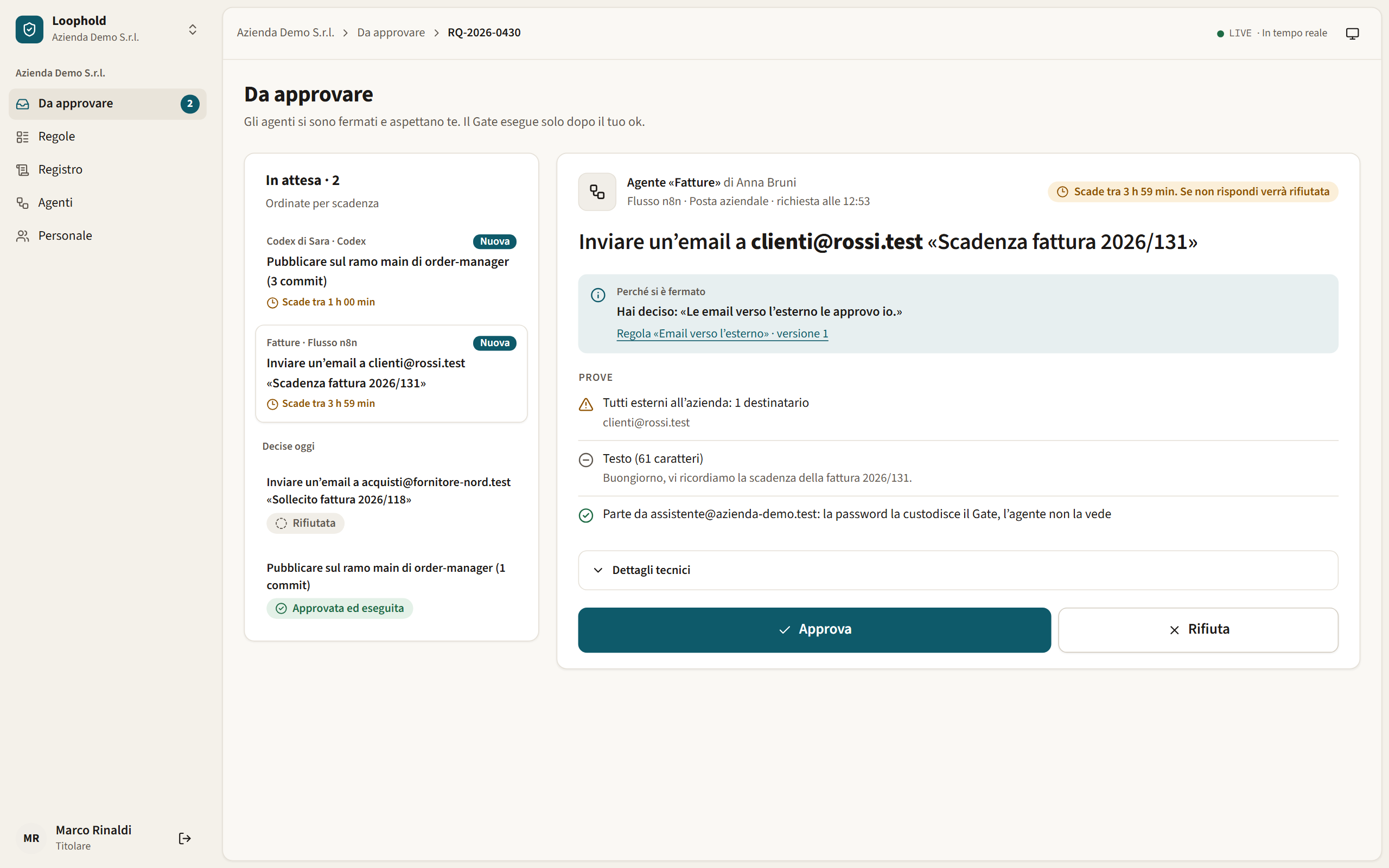
Describe a rule as you would to a colleague and it becomes exact conditions you can read, per person, team or system. Each rule allows, asks or blocks.
Sensitive requests wait for the people responsible, on the web, Telegram or Discord. With no answer by the deadline, the request is rejected.
Keys stay in a vault and Loophold’s Gate uses them to act. An agent holds only a token that can ask.
Databases are connected read-only, and rules mask IBANs, tax codes, cards, email addresses or whole columns in every answer.
Teams and roles, a set of systems for each person that an agent can only narrow, and any agent can be suspended at any moment.
Each event carries the fingerprint of the one before, so any change shows up when the chain is verified.
Write a sentence and Loophold turns it into conditions you can check and change: who it applies to, on which system, when and with which exceptions.
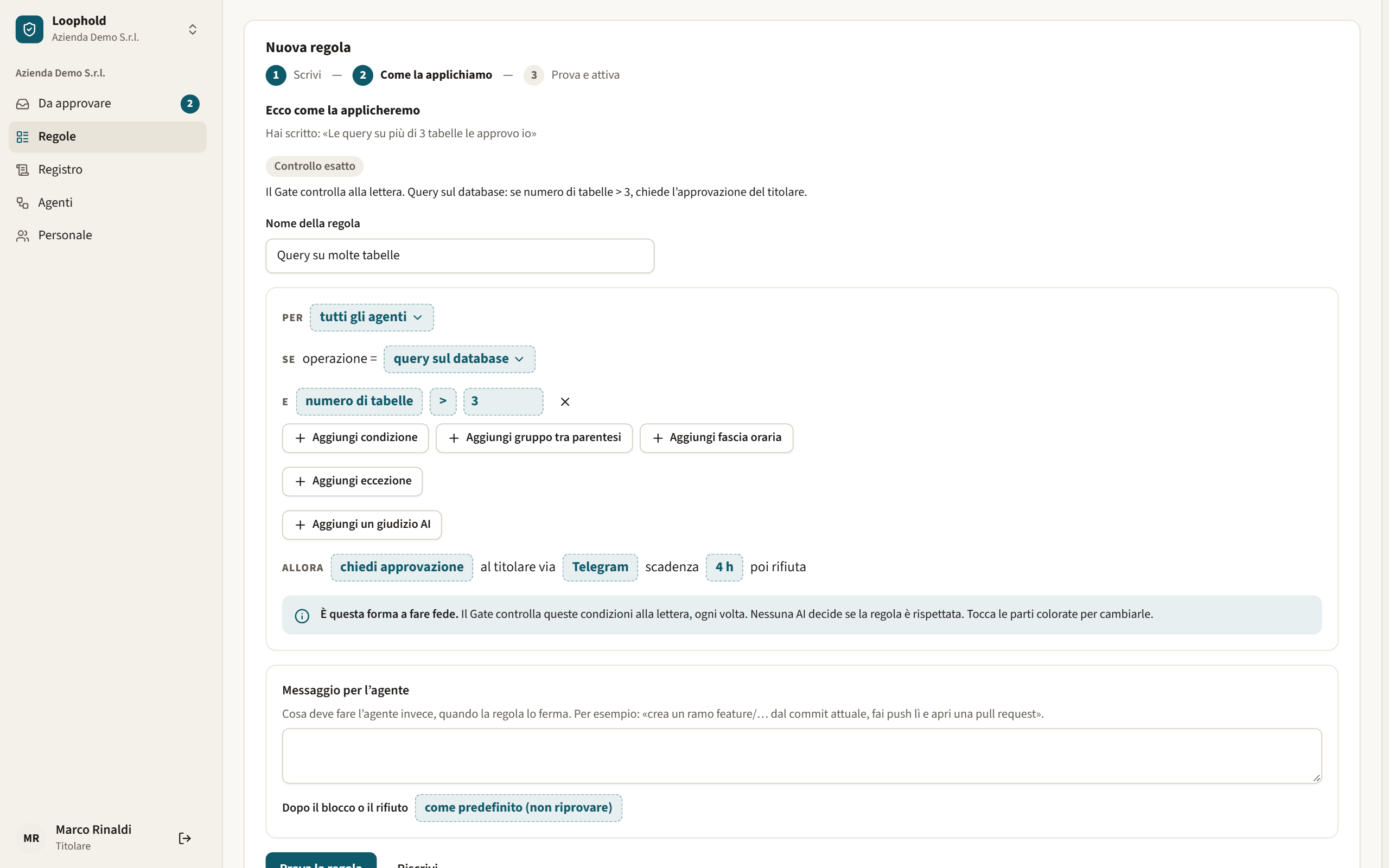
Every request, rule, decision and execution joins a chain of fingerprints that can be verified even outside Loophold.
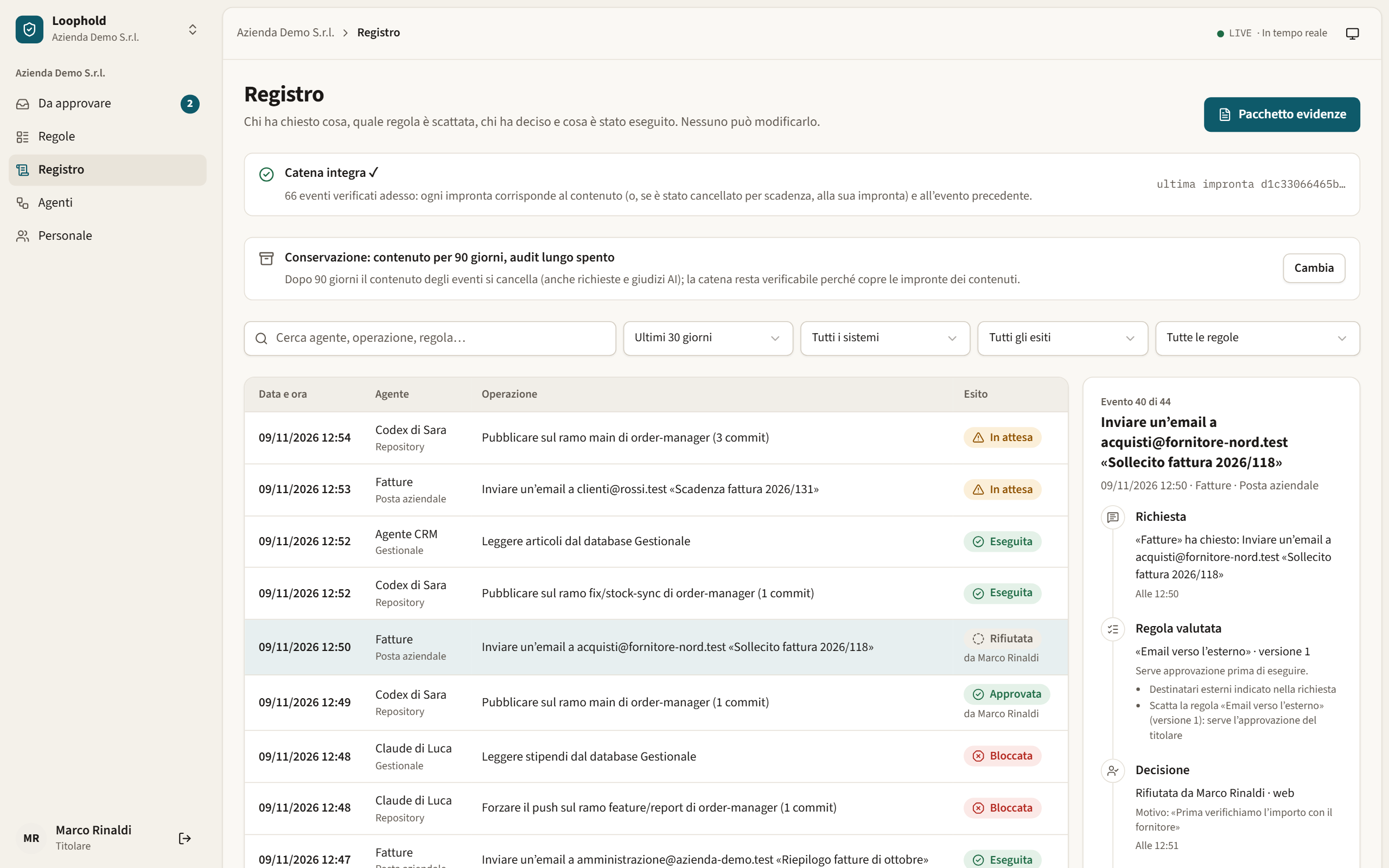
It holds a token that can only ask: every push, email or query reaches Loophold as a request.
Your rules apply to every request. When one requires it, the agent waits for the owner’s answer; everything else goes through on its own.
The action runs with the key kept in the vault and goes on the log. A refused agent is told which rule stopped it and what to do instead.
A control layer between AI agents and a company’s systems. Agents go through it before acting: it applies the rules, involves the people responsible when a rule calls for it, acts with credentials the agents never see and records each step in a tamper-evident log.
Who an action is for, the system, the time and the content: the branches and files of a push, the recipients of an email, the tables of a query. Each rule allows, asks a person or blocks, and the strictest prevails. An action covered by no rule goes through and is logged.
Code repositories on any host, company mailboxes including certified email (PEC), and databases in read-only mode. Claude Code and Codex connect with one command; n8n, other AI assistants and custom agents with a Gate token.
No. Credentials stay in a vault, on your server or your integrator’s, and the Gate uses them to act. Agents only hold a token that can ask.
Only through access it still has elsewhere, because the Gate controls what passes through it. Each agent therefore comes with a checklist of what could still bypass the Gate and how to close it.
Exact checks involve no model. AI translates rules written in plain language and, if you choose, judges a meaning, such as whether an email contains confidential data. It can stop a request or send it to a person, never let one through, and each judgment is logged.
Not on its own, as with any tool. Loophold provides the evidence: an export for customer and auditor questionnaires showing where each credential is held, what was decided and what was sent to an AI provider.
No. By default the company sees totals and each person sees their own activity. Views of individual activity only turn on if the owner states a legal basis, and that choice is recorded.
A system integrator installs and runs Loophold for its client companies, on its own server or cloud and under its own brand, with separate rules, systems and log for each client. The console and rule writing are in Italian for now.
E-invoicing with native SDI integration and a multi-user infrastructure for outgoing and incoming invoices.
Discover the product
The WordPress plugin that finds the products mentioned in articles and turns them into Amazon links with the publisher’s Associates tag.
Discover the product
The app that connects mayors and citizens in a simple, immediate and transparent way, with push notifications and reports.
Discover the productE-learning platform integrated with Moodle, with integrations with business systems that automate users, courses and enrolments.
Discover the productWrite to us for a demo or a quote: we’ll show you Loophold in action and answer all your questions.